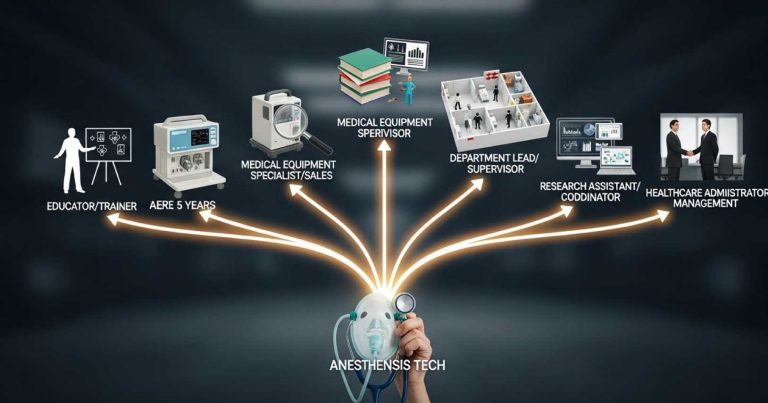
BLUF (Bottom Line Up Front): Yes, becoming an Anesthesia Technician is an exceptional stepping stone to becoming a CRNA, but it is not a shortcut. While the experience gives you an unmatched “toe-up” in understanding the Operating Room (OR) flow and anesthesia equipment, you must still earn a BSN, work as an ICU nurse, and obtain a Doctorate.
Introduction
The path to becoming a Certified Registered Nurse Anesthetist (CRNA) is one of the most rigorous in healthcare. On major forums like Reddit’s r/CRNA and allnurses, a recurring question from students is: “Will working as an anesthesia tech help me get into CRNA school?”
The short answer is yes, but with a massive asterisk. CRNA schools do not accept “anesthesia tech experience” in place of the mandatory “ICU nursing experience.” However, having both is considered a “superpower” in the admissions process.
In the spirit of Innovation in Technical Education, let’s look at how this role functions as a bridge, addressing the ground-level questions asked by aspiring providers in 2026.
The “Tech Advantage” in Admissions
Admissions committees for Doctor of Nursing Practice (DNP) programs are looking for candidates who won’t be overwhelmed by the OR environment. As a former tech, you arrive with “OR Fluency.”
- Machine Mastery: You already know how to troubleshoot the anesthesia machine (e.g., GE Avance or Dräger), while other nursing students might be seeing them for the first time.
- Provider Relationships: You work daily with the very people who will write your letters of recommendation: CRNAs and Anesthesiologists.
- The “Head of Bed” Perspective: You have seen hundreds of intubations and “difficult airways.” This visual experience is invaluable during your first year of CRNA clinicals.
Anesthesia Tech vs. ICU Nurse: The Critical Difference
This is the most misunderstood part of the journey. To become a CRNA, you must be a Registered Nurse (RN) with at least one year of high-acuity ICU experience.2
| Feature | Anesthesia Technician | ICU Nurse (The Mandatory Step) |
| Primary Focus | Hardware, supplies, and room turnover. | Hemodynamic monitoring and drug titration. |
| Patient Care | Indirect (assist with lines/positioning). | Direct (total management of critically ill). |
| Requirement for CRNA | Optional “Stepping Stone.” | Mandatory Requirement. |
| Value to School | Mechanical and OR flow expertise. | Clinical decision-making under pressure. |
Frequently Ask Questions
We’ve curated the top questions from high-impact nursing and anesthesia forums:
Q: “Can I use my 5 years as a tech to skip the 1-year ICU requirement?”
- Answer: No. Accreditation boards are strict. You must have at least one year of full-time ICU nursing experience. There are no exceptions for tech experience, regardless of how long you’ve worked.
Q: “Does being a tech help with the CRNA interview?”
- Answer: YES. Former techs often report that they can speak more confidently about “why anesthesia?” during interviews because they’ve seen the realities of the job, including the “boring” parts and the “crisis” moments.
Q: “Should I be an Anesthesia Tech or an ICU PCT while in nursing school?”
- Answer: If your goal is CRNA, Anesthesia Tech is superior. It gets you into the OR environment early. However, an ICU PCT (Patient Care Tech) job helps you land that first ICU nursing job more easily.
The Step-by-Step Roadmap: Tech to CRNA
If you are starting as a tech today, here is your “Innovation” timeline:
- Work as an Anesthesia Tech: Gain 1–2 years of experience while taking nursing prerequisites.
- Earn your BSN: Graduate from an accredited Bachelor of Science in Nursing program.
- Land an ICU Job: Secure a position in a high-acuity unit (CVICU, SICU, or MICU).
- Get Certified: Obtain your CCRN (Critical Care Registered Nurse) certification.
- Shadow & Network: Use your old anesthesia tech contacts to shadow CRNAs for 40+ hours.
- Apply to CRNA School: Highlight your unique blend of mechanical tech knowledge and ICU clinical skills.
Innovation Check: Mechanical Knowledge vs. Clinical Skill
At TechEdInn, we focus on how technology bridges education. In CRNA school, the learning curve is two-fold: learning the science of drugs and the mechanics of delivery.
- The Tech Advantage: You start school with the “mechanics” already mastered. You aren’t struggling to find the laryngoscope blades or the suction—you’re focusing on the patient’s physiology.
Final Verdict: Is It Worth the Extra Step?
If you have the time, being an anesthesia tech is the best possible preparation for the OR environment. It builds a foundation of confidence that nursing school alone cannot provide.
- Pros: Better recommendation letters, deeper understanding of OR culture, and a “leg up” in the first semester of clinicals.
- Cons: It adds time to your overall career timeline if you aren’t already a nurse.