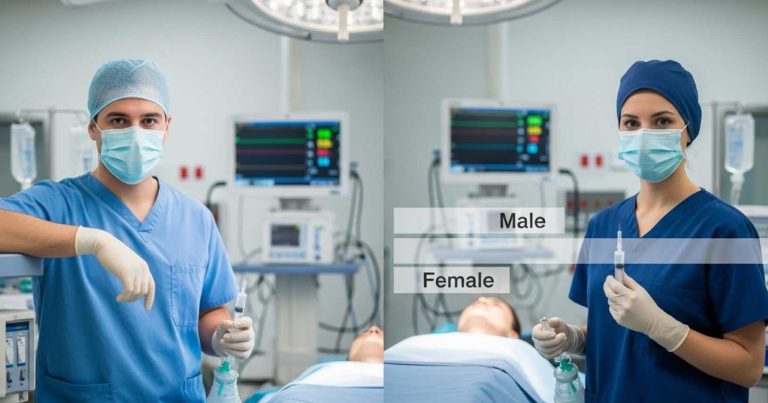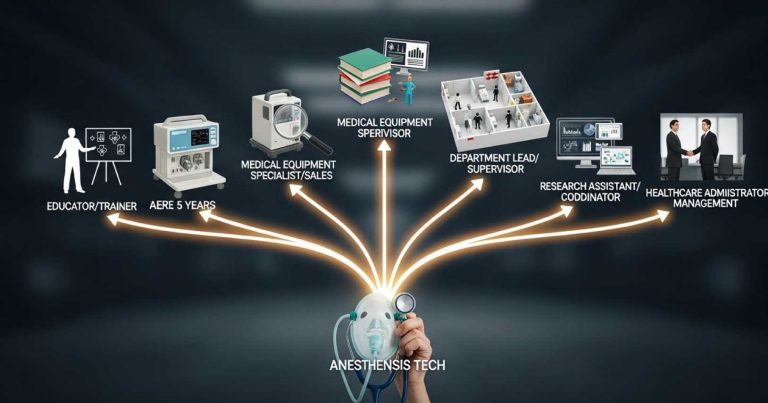
BLUF (Bottom Line Up Front): No, AI will not replace Anesthesia Technicians in the foreseeable future. Instead, 2026 marks the era of “Augmented Anesthesia,” where AI handles data-heavy tasks like predicting vitals and automating drug titrations, while humans remain essential for mechanical troubleshooting, patient empathy, and complex Operating Room (OR) orchestration.
Introduction
As we move into 2026, the question “Will a robot take my job?” has moved from science fiction to the hospital breakroom. With the rise of Closed-Loop Anesthesia Delivery and predictive algorithms that can spot a drop in blood pressure 15 minutes before it happens, the role of the Anesthesia Tech is fundamentally shifting.
However, the “Inn” of technical education is not closing; it’s being upgraded. At TechEdInn, we view the integration of Artificial Intelligence not as a threat of replacement, but as an Innovation that removes the “busy work” from your shift.
In this guide, we dive into the ground-level reality of AI in the OR and address the concerns of professionals who are worried about their career longevity.
Augmentation vs. Replacement: The 2026 Reality
In 2026, AI is becoming the “Autopilot” of the anesthesia world. Systems like McSleepy and other closed-loop platforms can now monitor a patient’s brainwaves (EEG) and automatically adjust the flow of Propofol or Sevoflurane to maintain a perfect depth of sleep.
Is this replacement? No. Just as a pilot is still required in a cockpit despite autopilot, a technician and a provider are required in the OR to:
- Supervise the System: AI can “hallucinate” or fail if a sensor becomes detached.
- Manage Unpredictability: AI follows algorithms; it cannot react to a surgeon suddenly nicking a major artery or a sudden power failure in the wing.
- Ethics and Liability: Hospitals and insurance providers still require a “human in the loop” for every life-critical decision.
The “Mechanical Moat”: Why AI Can’t Replace Your Hands
While AI is brilliant at processing data, it is historically poor at physical dexterity. This is the “Mechanical Moat” that protects Anesthesia Tech jobs.
- Equipment Setup: AI cannot yet unbox a fiberoptic scope, check it for cracks, and hand it to a provider in the exact orientation they need.
- Troubleshooting: When a machine leak test fails, an AI can tell you that it failed, but an Anesthesia Tech finds the tiny cracked O-ring or the loose breathing circuit.
- Emergency Response: During a “Code Blue,” a tech’s ability to physically move machines, grab a “Crash Cart,” and assist with chest compressions is something a software algorithm cannot do.
Predictive Anesthesia: The Tech’s New Best Friend
The biggest Innovation in 2026 is Predictive Analytics. Instead of reacting to an alarm, techs are now working with “Early Warning Systems.”
- HPI (Hypotension Prediction Index): This AI tool analyzes arterial waveforms to predict low blood pressure before it happens. Techs now prepare vasopressors in advance rather than in a panic.
- Smart Inventory: AI-powered “Smart Cabinets” (like upgraded Pyxis systems) now predict which drugs will be needed for the day’s schedule, automating the restocking process that used to take hours of a tech’s shift.
💡 Inn-Sider Tip: The most valuable techs in 2026 are those who act as “System Orchestrators.” Learning how to calibrate these AI sensors and interpret their data makes you a high-value “Technical Expert” rather than just a stocker.
What Reddit & Forums are Saying About AI Burnout
On forums like Reddit’s r/anesthesiology, the conversation has shifted from “Will I lose my job?” to “How do I manage all this new tech?”
“The stress isn’t gone; it’s just different. I don’t have to worry about the pharmacy being out of stock anymore because the AI handles that, but I DO have to worry about the AI monitor’s software update glitching mid-case.” — Verified User, Reddit
“Honestly, the AI makes my job better. I spend less time doing paperwork and more time actually helping with the ‘cool’ stuff like nerve blocks and difficult airways.” — Student Doctor Network Post
Future Job Outlook: Growth in the Age of Automation
Despite the rise of AI, the Bureau of Labor Statistics (BLS) and 2026 labor studies show a 5% to 7% growth in Anesthesia Tech jobs.
- The “Aging” Factor: As the population ages, the number of surgeries is skyrocketing. Technology cannot keep up with the sheer volume of patients without more human staff.
- The “Complexity” Factor: Surgeries are becoming more complex (Robotics, Transplants). These “high-tech” rooms require more technical support staff, not less.
Frequently Asked Questions
Q: Should I still go to school for Anesthesia Tech if AI is growing?
A: Yes. In fact, the “Technical” part of your title is becoming more important. Focus on a program that includes Computer Literacy and Digital Medical Systems to be future-proof.
Q: Will AI lower my salary?
A: Likely the opposite. As the job moves from “manual labor” to “technical orchestration,” the required skill level increases, which historically leads to higher pay brackets.
Q: Can AI perform an intubation?
A: There are robotic prototypes, but they are expensive, bulky, and not ready for the “messy” reality of human anatomy in an emergency. Humans will be the primary airway managers for decades to come.
Master the Future at the “Inn”
At TechEdInn, we believe that Innovation in Technical Education is about embracing the tools of tomorrow to save lives today. AI isn’t your replacement—it’s your new power tool.